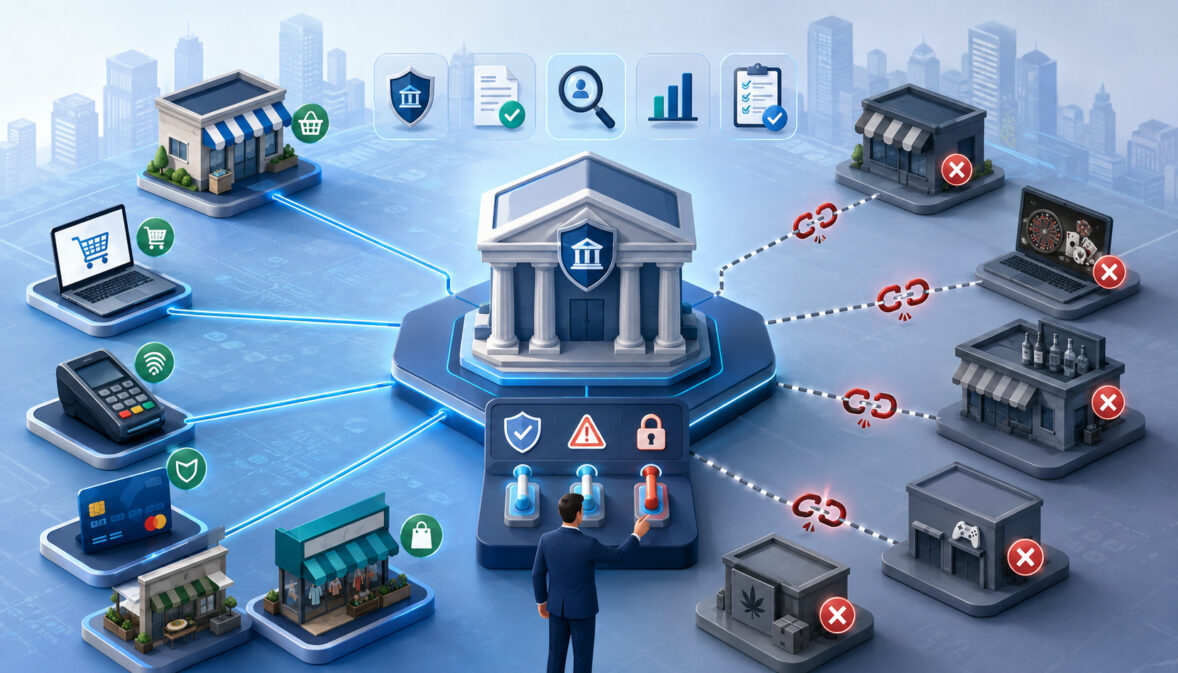
Bank De-Risking and Account Closures: Why Banks Exit Entire Merchant Categories and What It Costs Them
A business can bank successfully for years and still receive a notice saying its account or payment-processing relationship will end. To the merchant, a sudden merchant bank account closure may feel abrupt or inexplicable.
Inside the financial institution, however, the decision may follow months of portfolio analysis, compliance reviews, fraud trends, regulatory developments, policy changes, or reevaluation of the bank’s willingness and ability to manage a particular type of risk.
The central issue is straightforward: Banks may exit a merchant category when the expected compliance, fraud, legal, operational, credit, or reputational risk outweighs the revenue and strategic value of serving that category.
That does not mean regulators universally order banks to stop serving particular lawful industries. Federal banking agencies have repeatedly emphasized risk-based customer assessment.
A joint agency statement says no customer type presents a single uniform money-laundering or illicit-finance risk and notes that, as a general matter, agencies do not direct banks to open, close, or maintain particular accounts.
At the same time, banks are businesses with their own risk appetite, compliance capabilities, product strategies, capital constraints, technology systems, and profitability requirements. Two institutions can evaluate the same merchant category and reach different conclusions without either conclusion automatically being improper.
Understanding bank de-risking merchant accounts therefore requires separating several issues that are often blended together: regulatory obligations, bank policy, merchant-specific behavior, category-level exposure, deposit banking, payment processing, fraud, AML risk, and the economics of maintaining difficult relationships.
This article is informational and does not provide individualized legal, regulatory, or compliance advice. Businesses facing a significant account termination, funds restriction, enforcement issue, or contractual dispute should consider advice from appropriately qualified professionals.
What Is Bank De-Risking?
Bank de-risking generally refers to a financial institution reducing its exposure to customers, products, jurisdictions, activities, or relationships that it believes create unacceptable or uneconomic risk.
The term is sometimes used very broadly. In policy discussions, however, it often has a narrower meaning involving indiscriminate or wholesale restriction of broad groups instead of customer-specific risk analysis.
The U.S. Treasury’s strategy addressing financial-sector de-risking distinguishes broad, indiscriminate exits from legitimate decisions in which an institution concludes that it cannot adequately manage a particular customer’s risk.
Treasury also identified profitability, compliance expense, risk appetite, regulatory burden, and related considerations as drivers of de-risking.
In practice, financial institution de-risking may involve:
- declining to onboard certain customers;
- terminating individual deposit accounts;
- restricting particular products or transaction types;
- reducing exposure to specific jurisdictions;
- stopping correspondent banking services;
- ending relationships with payment processors;
- withdrawing from merchant acquiring;
- imposing enhanced controls or reserves;
- or deciding that an entire category no longer fits the bank’s strategy.
The critical distinction is between risk management and blanket avoidance. Banks are expected to identify and control risk. The policy concern arises when categories are treated as uniformly unacceptable without adequate differentiation among customers that present materially different risk profiles.
De-Risking vs. Routine Account Closure
Not every bank account termination is evidence of business account de-risking.
An individual account may be closed because the merchant violated account terms, failed to provide requested documentation, generated unusual activity, accumulated unpaid obligations, misrepresented its operations, experienced excessive fraud, or simply no longer fits the institution’s commercial strategy. Those decisions may be customer-specific rather than part of mass merchant account terminations.
Category-level de-risking is broader. A bank may decide, for example, that it lacks the staffing, systems, specialist knowledge, legal certainty, monitoring capability, or expected financial return required to continue supporting a certain type of business. Existing customers may then be offboarded even if some have individually maintained satisfactory account histories.
This difference matters when interpreting a closure. A merchant banking relationship termination does not, by itself, reveal whether the cause was individual conduct, portfolio economics, a change in bank risk appetite, a compliance problem, an acquisition, a contractual issue, or a broader category exit.
What Is a Merchant Account Closure?

“Merchant account closure” can describe several fundamentally different events. Businesses should first determine which financial relationship is actually being terminated.
A business deposit account is typically a checking, savings, or other deposit relationship used to receive funds, pay employees and suppliers, hold working capital, and conduct ordinary treasury activity. Bank account termination affects access to these banking functions.
A merchant processing account, by contrast, generally relates to accepting card payments. The acquiring bank and its processing partners face risks associated with settlement, chargebacks, refunds, fraud, card-network requirements, and merchant performance.
An acquiring relationship termination may end the bank’s or acquirer’s willingness to sponsor or process a merchant’s card transactions. This can occur even while the merchant’s separate business checking account remains open.
A payment gateway suspension concerns technology transmitting transaction information and may occur without either the deposit bank or acquiring bank closing an account.
Finally, a fintech or platform account closure can involve a nonbank customer interface whose underlying banking services depend on one or more partner or sponsor banks. The customer’s relationship with the platform and the platform’s relationship with its sponsor bank are separate layers.
Keeping these distinctions clear prevents one of the most common misunderstandings about high-risk merchant accounts.
| Issue | Deposit Account | Merchant Processing |
| Primary function | Holds and transfers business funds | Accepts and settles card payments |
| AML monitoring | Significant | Relevant, depending on structure |
| Chargeback exposure | Usually indirect | Major acquiring risk |
| Credit exposure | Depends on products and overdrafts | Can arise from refunds and chargebacks |
| Transaction monitoring | Yes | Yes, with different objectives |
| Card-network rules | Generally not central | Central |
| Reserves | Uncommon as a normal deposit feature | May be required under processing terms |
| Termination consequence | Loss of banking relationship | Loss of card-processing capability |
The OCC’s Merchant Processing guidance emphasizes that acquiring banks can retain significant exposure to merchant activity, especially through chargebacks and settlement obligations.
That is why payment processing de-risking should not automatically be interpreted as deposit-account de-risking, even when both happen to the same business.
Why Banks Exit Entire Merchant Categories
A bank may leave an entire merchant category when managing customer-by-customer differences becomes operationally difficult, financially unattractive, or inconsistent with the institution’s risk capacity.
The decision is rarely reducible to one variable. Merchant category risk can combine AML exposure, fraud losses, sanctions screening, licensing obligations, customer complaints, recurring-billing disputes, chargebacks, cross-border activity, legal uncertainty, third-party dependencies, and costly manual review.
Consider economics. A category generating attractive deposits and fee income may still be unattractive if it requires specialist underwriters, unusually intensive transaction monitoring, repeated legal opinions, enhanced due diligence, frequent escalation, large fraud-loss provisions, reserve administration, or high levels of dispute handling.
Treasury’s de-risking analysis found that profitability can be central to these decisions because the cost of controlling risk directly affects the value of the relationship.
Banks may also consider concentration. Even if each merchant appears acceptable independently, a portfolio heavily concentrated in one higher-volatility business model could expose the institution to correlated fraud, regulatory, credit, liquidity, or operational shocks.
Bank Risk Appetite Explained
Bank risk appetite is the amount and type of risk an institution is willing to accept while pursuing its business objectives.
Risk appetite is not the same thing as the legal boundary. A lawful activity can still fall outside a bank’s strategy. Conversely, a customer type requiring enhanced controls is not automatically prohibited.
One institution may have dedicated compliance specialists, sophisticated monitoring technology, experienced merchant underwriters, strong capital resources, and enough customer volume to spread fixed compliance costs across a large portfolio. Another may lack those advantages and determine that the same business would be uneconomic or operationally difficult.
The FFIEC’s BSA/AML risk-assessment framework reflects this institution-specific approach. Bank risk assessments consider products, services, customers, geographic exposure, and other characteristics rather than relying on a single indicator.
This helps explain why one merchant may retain banking access while a similar merchant receives a termination notice elsewhere. Different institutions can have different controls, strategies, customer mixes, concentration limits, systems, and business objectives.
Regulatory Risk vs. Bank Policy
This distinction is essential.
Some transactions are prohibited by law or sanctions. Other activities are legal but require additional compliance controls, licensing verification, monitoring, reporting, or customer due diligence. Still others may be lawful and manageable yet fall outside a particular institution’s voluntarily adopted policies.
Federal regulators have explicitly cautioned against treating every customer of a particular type as presenting the same BSA/AML risk. The agencies have said compliant banks are neither prohibited nor discouraged from serving any specific class or type of customer and have encouraged customer-specific risk management rather than wholesale category rejection.
Therefore:
- Legal prohibition means the activity cannot lawfully be supported under applicable rules.
- Regulatory obligation means the bank must satisfy specified compliance responsibilities.
- Heightened risk management means more controls may be appropriate based on facts and circumstances.
- Bank policy reflects the institution’s own decision about the risks and businesses it will accept.
- Economic exit occurs when the cost of controlling risk exceeds anticipated value.
Confusing these categories can cause merchants to assume a regulator “banned” their industry when the actual reason may be an internal portfolio decision.
How Banks Assess High-Risk Merchant Accounts

“High-risk merchant” is not a universal legal classification with one definition applicable to every bank and every financial product.
In practice, the term usually describes a customer or business model requiring more intensive underwriting, monitoring, controls, reserves, documentation, or management attention because of identifiable risk characteristics. Those characteristics vary by institution and by relationship.
A merchant may receive additional scrutiny because of recurring billing, unusually high dispute activity, cross-border transactions, complex ownership, rapid growth, licensing requirements, age-restricted products, delayed fulfillment, large ticket sizes, cash intensity, higher fraud exposure, regulatory complexity, or elevated refund rates.
None of those factors automatically establishes wrongdoing.
Merchant underwriting generally examines both inherent risk and available mitigation. Typical factors include:
- ownership and beneficial owners;
- business history and financial condition;
- expected transaction volume and size;
- source and destination of funds;
- customer and supplier relationships;
- geographic exposure;
- licensing and registrations;
- products and services offered;
- websites and marketing practices;
- chargebacks and returns;
- fraud history;
- customer complaints;
- AML and sanctions controls where applicable;
- counterparties;
- payment methods;
- expected seasonal changes;
- and historical account behavior.
Enhanced Due Diligence
Enhanced due diligence is additional investigation performed when risk characteristics justify information beyond standard onboarding.
Depending on the relationship, a bank may request incorporation records, ownership information, licenses, supplier agreements, contracts, financial statements, policies, transaction records, source-of-funds information, customer data, fulfillment evidence, or explanations for particular payment flows.
The objective is normally to understand whether the institution can identify, measure, monitor, and control the risk presented by the customer. More documentation does not necessarily mean the bank suspects criminal activity.
For merchants, incomplete or inconsistent responses can create problems because the bank may be unable to validate the business model originally presented during onboarding. A company that operates legitimately but cannot document material aspects of its activities can still be difficult to underwrite.
Enhanced due diligence also tends to be expensive. It may require compliance analysts, investigators, legal review, manual monitoring, relationship-manager time, escalation committees, and repeated refreshes of customer information. Those costs influence high-risk merchant de-risking decisions.
Transaction Monitoring and Account Reviews
Bank monitoring does not end after onboarding.
Ongoing transaction monitoring can identify activity that differs materially from the customer profile used during underwriting.
Relevant signals may include sudden volume growth, unexplained incoming wires, unexpected international transactions, unusual counterparties, abnormal ACH returns, fraud patterns, rapid movement of funds, chargeback spikes, or transactions inconsistent with the stated purpose of the account.
The FFIEC framework expects banks to understand the nature and purpose of customer relationships, develop customer risk profiles, and conduct appropriate ongoing monitoring.
A transaction anomaly does not necessarily prove improper conduct. A legitimate merchant may grow rapidly, add suppliers, enter a new market, acquire another business, change billing models, or receive an unusually large payment.
The problem is often a gap between what the bank expects and what it sees.
Why Banks Choose Portfolio-Level De-Risking
Individual merchant review may appear more equitable than a category exit, but individual review has real fixed costs.
Suppose a bank determines that serving a particular sector requires specialized licensing expertise, new monitoring scenarios, dedicated fraud analysts, outside counsel, enhanced underwriting, frequent customer-document refreshes, and complex escalation procedures. Those expenses can apply whether the portfolio includes 50 merchants or 5,000.
If the category does not generate enough revenue to support that infrastructure, the institution may reduce exposure instead of investing more heavily.
Portfolio-level decisions can also result from:
- new fraud patterns affecting many merchants;
- changes in litigation exposure;
- sanctions developments;
- card-network requirements;
- new licensing obligations;
- internal audit findings;
- regulator findings involving controls;
- merger integration;
- third-party failures;
- higher operating losses;
- concentration limits;
- or a strategic decision to focus on other customer segments.
The result may be mass merchant account terminations even though not every affected business has generated an individual compliance problem.
Merchant Category Exit Decision Table
| Risk Factor | Why It Matters to the Bank | Possible Mitigation |
| AML exposure | May increase investigation and monitoring requirements | Strong onboarding, risk-based monitoring, documented controls |
| Fraud losses | Can create direct losses and customer harm | Fraud detection, authentication, tighter underwriting |
| Chargebacks | Can expose acquirers to merchant credit risk | Reserves, monitoring, fulfillment controls |
| Regulatory complexity | Raises expertise and compliance costs | Specialist staff, legal analysis, compliance systems |
| Licensing risk | Invalid or missing licenses can create legal exposure | Verification and recurring license reviews |
| Sanctions exposure | Cross-border activity may require extensive screening | Screening, geographic controls, escalation |
| Operational burden | Manual reviews can make relationships expensive | Automation, data quality, workflow improvements |
| Concentration risk | Correlated losses can affect portfolio resilience | Exposure limits and diversification |
| Weak economics | Revenue may not cover oversight and losses | Pricing, minimum volume, narrower product scope |
| Public-perception concerns | Customer relationships may create business consequences | Governance focused on measurable legal, financial, and operational effects |
The treatment of “reputation risk” in bank supervision has changed materially. The Federal Reserve stopped using reputational risk as a component of its examination programs, while the OCC and FDIC subsequently adopted a final rule eliminating reputation risk from their supervisory programs.
That rule became effective on June 9 and does not itself impose new obligations on supervised banks. The agencies have also continued removing reputation-risk references from interagency supervisory materials.
That does not mean public reaction has become irrelevant to bank management. A bank may still evaluate measurable business consequences associated with customer relationships under its own governance and applicable law. The important distinction is between a bank’s internal business decision and a regulator using standalone reputation risk as a supervisory basis.
Why Sudden Merchant Bank Account Closures Happen
An account closure can appear sudden even when the bank’s internal review has been underway for weeks or months.
Merchants generally do not see internal alert queues, compliance committee discussions, portfolio reports, fraud analytics, policy reviews, examination findings, legal analyses, or risk-management deliberations. A final closure notice may therefore be the first visible sign of a much longer decision process.
Potential triggers include:
- a change in bank risk appetite;
- new account behavior;
- adverse information;
- fraud or chargeback increases;
- unresolved due-diligence requests;
- merger integration;
- product restructuring;
- regulatory or audit findings;
- new legal uncertainty;
- third-party or sponsor-bank changes;
- geographic expansion;
- or a category-level policy decision.
A long history with the institution can be favorable evidence, but it does not guarantee continued access. The risk profile, bank strategy, economics, and regulatory environment can all change.
Why Banks May Give Limited Explanations
A bank may be able to provide a general reason for merchant account termination, but the level of detail varies substantially.
Account agreements may give institutions contractual termination rights subject to applicable law. Operational security, fraud prevention, litigation concerns, confidential investigative processes, law-enforcement restrictions, and other considerations can limit what staff will discuss.
Suspicious activity reporting requires particular care. A Suspicious Activity Report and information revealing whether a SAR exists are confidential under federal rules. FinCEN’s SAR filing requirements expressly address that confidentiality.
Consequently, merchants should not assume that limited disclosure proves the bank had no reason for acting. Nor should they assume that limited disclosure necessarily means a SAR was filed.
Notice periods also vary based on the product, agreement, applicable legal requirements, the reason for termination, and circumstances such as suspected fraud or account misuse. There is no responsible way to state that every business closure must receive the same notice or explanation.
De-Risking vs. “Debanking”
“Debanking” and “de-risking” overlap but are not precise synonyms.
“Debanking” is often used broadly to describe loss or denial of banking services, regardless of the reason. Public discussions may apply it to an individual account closure, industry restriction, political controversy, compliance decision, or other termination.
“De-risking” generally describes risk-reduction behavior by financial institutions. Treasury has used the term more specifically for wholesale or indiscriminate restrictions affecting broad groups instead of targeted risk assessment.
Neutral analysis therefore requires asking what actually happened rather than relying on the label. Was one account closed? Did the bank leave an entire category? Was a processor terminated? Did a sponsor bank change policy? Was activity legally prohibited? Did the customer fail due diligence?
Those facts usually matter more than terminology.
De-Risking, AML, Fraud, Chargebacks, and Legal Uncertainty
AML concerns receive substantial attention in discussions of bank de-risking merchants, but they are only one part of the risk equation.
BSA AML risk management requires institutions to identify and manage exposure to money laundering, terrorist financing, and other illicit financial activity. The regulatory model is risk-based rather than built around the assumption that every customer within a broad category is equally risky.
Federal agencies have repeatedly emphasized that customer type alone should not be treated as determinative.
At the same time, serving customers with more complex activity may require more expensive systems, specialist expertise, documentation, alert investigation, and quality assurance. That makes compliance cost banking economics important even when an institution believes some merchants in the category could be safely served.
Fraud and Chargebacks Are Different From AML Risk
Fraud risk concerns deception, unauthorized transactions, account takeover, payment abuse, false representations, and direct financial loss. AML risk concerns the potential use of financial services for money laundering, terrorist financing, or related illicit-finance activity.
They can overlap, but they should not be treated as interchangeable.
A merchant category could have relatively manageable AML characteristics yet poor fraud economics. High losses, unauthorized transactions, excessive refunds, consumer complaints, or expensive manual reviews may make the portfolio unattractive independently of BSA concerns.
Chargebacks create another distinct issue in acquiring. Because acquiring banks may face exposure when merchants cannot satisfy valid refunds or chargebacks, merchant acquiring risk can resemble contingent credit risk.
The FDIC’s guidance on payment-processor relationships discusses monitoring return activity, complaints, fraud indicators, due diligence, underwriting, and reserve arrangements in higher-risk payment-processing relationships. The guidance was revised to remove references to reputation risk while retaining its emphasis on other material risks.
This distinction explains why an acquiring bank may terminate processing while a deposit institution remains comfortable maintaining the business’s checking account.
Legal and State-Level Regulatory Uncertainty
Legal uncertainty can create costs even when an activity is not categorically prohibited.
Some business models involve licensing regimes, product restrictions, disclosure requirements, consumer-protection obligations, or operational rules that differ across jurisdictions. A company serving customers nationally may therefore create a much more complicated legal-control environment than a local business offering the same general product.
Banks must determine whether they understand the applicable requirements well enough to manage the relationship. That may require license verification, jurisdictional restrictions, contractual representations, specialist legal review, and ongoing monitoring for regulatory changes.
Uncertainty also matters because compliance systems need clear rules. If a bank cannot reliably identify which transactions are permitted, where an activity may occur, or which licenses are necessary, it may narrow the product or stop serving the category.
This is an economic as well as legal decision. Legal ambiguity creates staffing costs, technology requirements, documentation burdens, and the possibility of operational mistakes.
Fintech, Sponsor Banks, Payment Processors, and Mergers
Modern banking relationships are frequently layered.
A business may interact with a fintech brand while deposits are held at a partner bank, payments are processed by another institution, cards are sponsored by a separate bank, and technology infrastructure comes from multiple service providers. When one critical institution changes its risk appetite, downstream customers may feel the impact.
The broader importance of bank-fintech dependencies is discussed in Banking Industry Review’s overview of how banks are adapting to fintech partnerships. Such partnerships can expand services, but they also create governance, compliance, security, and operational dependencies.
A fintech may therefore have acceptable customers under its own policies but still lose the ability to serve them if its sponsor bank narrows eligible industries.
Sponsor Bank and Third-Party Dependence
Sponsor-bank dependency creates a concentration risk for fintech operators.
If one bank provides the core regulated account infrastructure supporting thousands of downstream customers, a policy change at that bank can have effects far beyond one contractual relationship. The fintech may need to migrate accounts, change eligible activities, redesign products, or terminate customers.
Similar concentration exists in technology infrastructure. Banking Industry Review’s discussion of cloud banking and third-party governance highlights the importance of due diligence, operational resilience, oversight, and exit planning in outsourced arrangements.
Transition planning matters because a sponsor-bank exit cannot always be resolved simply by finding another institution. The replacement bank must approve the program, conduct due diligence, integrate systems, negotiate agreements, establish controls, and become comfortable with the customer base.
Consolidation and Bank Mergers
Bank mergers can also trigger merchant category reviews.
An acquired institution may have served customer types that the acquiring institution does not support. During integration, the combined bank may standardize restricted-industry policies, underwriting requirements, monitoring systems, risk ratings, geographic limits, and product offerings.
This can lead to closures involving customers whose behavior has not materially changed.
The BSA/AML Examination Manual specifically recognizes that changes such as mergers, acquisitions, new products, new services, and new customer types can affect an institution’s risk assessment.
For merchants, a merger is therefore a sensible time to verify whether existing services will continue and whether updated documentation will be required.
What De-Risking Costs Banks
De-risking reduces certain exposures, but it is not cost-free.
The most obvious cost is foregone revenue. A category exit can eliminate deposits, treasury-management fees, card-processing revenue, lending relationships, interchange-related economics where applicable, foreign-exchange activity, payment volume, and opportunities to sell other financial services.
A valuable commercial customer may have multiple products with the bank. Closing the operating account can therefore mean losing the entire relationship rather than one isolated revenue stream.
Treasury’s research is particularly useful here because it connects de-risking decisions to profitability. Compliance expense does not exist separately from revenue analysis; it changes the economics of the customer relationship.
Compliance Savings vs. Revenue Loss
A bank evaluating an exit effectively faces a portfolio equation:
Expected relationship value − expected losses − compliance cost − operational cost − capital and liquidity effects − strategic risk = risk-adjusted economic value.
This is not necessarily a formal formula used by every institution, but it illustrates the tradeoff.
A portfolio may produce substantial revenue yet still have poor risk-adjusted economics. Conversely, investing in specialized compliance capabilities can make a category attractive when sufficient scale exists.
Exiting may reduce alert volumes, investigations, enhanced due diligence, legal expenses, specialist staffing, dispute operations, fraud losses, card-network exposure, reserves administration, or audit remediation. But it may also surrender deposits and customers to competitors capable of managing those risks.
This can create an opportunity for specialized institutions. Market knowledge, better underwriting data, superior controls, and operational expertise can turn a category one bank views as uneconomic into a sustainable segment for another.
Investigating and Offboarding Customers Also Costs Money
Mass merchant account terminations require significant operational work.
Banks may need to:
- review accounts and documentation;
- obtain legal and compliance approvals;
- establish closure timing;
- calculate outstanding obligations;
- communicate with customers;
- manage checks and ACH transactions;
- address incoming funds;
- handle complaints and escalations;
- administer reserves or chargeback exposure;
- redirect merchant settlement;
- and preserve required records.
A category exit can therefore create immediate implementation expense before any long-term compliance savings appear.
There can also be customer-service and reputation consequences in the ordinary commercial sense. Long-standing businesses may move loans, payroll, deposits, treasury services, and personal banking relationships elsewhere. Communities and industry associations may become reluctant to use the institution.
At the same time, continuing a relationship that generates severe losses, legal risk, fraud, customer harm, or operational strain can create its own damage. Banks must evaluate both sides.
What De-Risking Costs Merchants, Consumers, and Competition
For a merchant, loss of banking access can affect basic business continuity.
A deposit-account closure may interrupt payroll, supplier payments, tax payments, cash management, incoming ACH transactions, check clearing, wires, and access to operating funds. Merchant-processing termination can prevent card acceptance even though the business still has a bank account.
Replacement relationships may also be more expensive. A business can face new onboarding fees, reserves, higher processing costs, additional documentation requirements, slower settlement, limited products, or the administrative burden of managing several providers.
For smaller firms, management time itself is a meaningful cost.
Treasury and GAO research has documented broader de-risking concerns, particularly where affected financial businesses or remittance providers moved activity toward less convenient or less regulated channels. GAO reported instances in which money transmitters that lost banking access used nonbanking methods that increased operating costs and exposure to risk.
Competition and Financial Inclusion
If many banks exit the same category, the remaining providers gain a larger share of the available market.
That concentration can reduce negotiating leverage for merchants and create systemic dependency on fewer banks or processors. It may also increase the consequences of a policy change at one of the remaining providers.
Widespread exits can affect financial inclusion as well. Treasury has warned that excessive de-risking can push legitimate financial activity outside regulated channels and restrict access to mainstream services.
The policy challenge is not eliminating risk controls. Effective AML, sanctions, fraud, safety-and-soundness, and consumer-protection measures remain essential.
The challenge is preserving a risk-based system capable of distinguishing legitimate but complex customers from relationships whose risks cannot be adequately managed.
Banking Industry Review’s discussion of fintech and financial inclusion provides additional context on how alternative financial technologies can expand access, although those systems bring their own compliance, fraud, privacy, operational, and third-party risks.
Bank De-Risking Risk/Cost Framework
| Stakeholder | Potential Benefit | Potential Cost |
| Bank | Lower losses, complexity, monitoring burden, and concentration | Lost deposits, fees, lending, customer lifetime value, market knowledge |
| Merchant | May prompt stronger controls or better-fit provider | Payment disruption, higher costs, operational instability |
| Consumers | Reduced exposure to poorly controlled fraud or unlawful activity | Reduced choice, higher merchant costs, possible service disruption |
| Payment ecosystem | Lower exposure to weak participants | Greater provider concentration and migration outside mainstream channels |
| Regulators | Better-controlled institutions when genuine risks are reduced | Overly broad exits can undermine risk-based compliance and financial access |
How Merchants Can Reduce Avoidable De-Risking Risk
No compliance checklist can guarantee that a bank will keep an account open. Institutions can change strategy even when a merchant has done nothing wrong.
Businesses can, however, reduce avoidable risk signals by making their operations easier to understand and verify.
Start with accurate onboarding. The business description should reflect what the company actually sells, how customers pay, where transactions occur, who owns the company, what volumes are expected, which jurisdictions are involved, and how funds move.
Keep that information current. Important changes may include:
- ownership;
- physical or mailing address;
- websites and domains;
- product lines;
- suppliers;
- expected transaction volume;
- average ticket size;
- cross-border activity;
- jurisdictions;
- recurring billing;
- fulfillment model;
- account purpose;
- and payment channels.
A bank that expects $150,000 in monthly domestic revenue may reasonably investigate when the account suddenly begins receiving several million dollars in international transfers. The growth may be legitimate, but the unexplained change can still require review.
Maintain Compliance and Business Documentation
Documents should be organized before the bank requests them.
Depending on the business, useful records may include:
- incorporation documents;
- beneficial ownership records;
- current licenses;
- financial statements;
- tax records;
- supplier and customer contracts;
- invoices;
- source-of-funds documentation;
- refund and fulfillment policies;
- transaction records;
- compliance policies;
- and AML procedures where relevant to the business.
Merchants accepting cards should also monitor disputes, fraud, returns, refund delays, and chargeback trends. Waiting until an acquirer identifies a deterioration can reduce the available time to correct it.
For regulated businesses, license expiration is particularly avoidable. A company may still believe it is authorized to operate, but documentation gaps can prevent the bank from reaching the same conclusion.
Know the Bank’s Restricted-Industry Policy
Businesses should review deposit agreements, merchant agreements, acceptable-use rules, restricted-activity policies, and onboarding disclosures before depending heavily on an institution.
Important questions include:
- Does the bank serve our exact business model?
- Which activities are prohibited or restricted?
- What documentation must remain current?
- What transaction changes require notification?
- Are periodic enhanced reviews expected?
- What return or chargeback metrics matter?
- Are merchant reserves possible?
- How are policy changes communicated?
- What is the termination process?
- How should major business changes be reported?
The answers can change over time, so merchants should not assume an approval obtained several years ago permanently establishes eligibility.
What to Do After a Sudden Bank Account Closure
A sudden merchant bank account closure should be treated as an operational-continuity event.
The immediate objective is to understand the available timeline, protect access to funds, redirect critical payments, and determine whether a replacement relationship is needed.
- Read the notice carefully: Identify the product being terminated and whether related accounts are affected.
- Confirm key dates: Determine when transactions will stop and how remaining funds will be returned.
- Contact the institution through official channels: Ask what information it is permitted to provide and whether any review or escalation process exists.
- Document communications: Keep notices, names, dates, account references, and correspondence.
- Identify outstanding obligations: Review payroll, tax payments, ACH debits, subscriptions, wires, checks, refunds, and chargebacks.
- Redirect incoming payments: Update customers, processors, marketplaces, and other payers as necessary.
- Establish replacement banking or processing: Provide accurate information during the new underwriting process.
- Investigate underlying risk issues: Look for licensing gaps, fraud, chargebacks, unexplained transactions, ownership changes, or compliance deficiencies.
- Notify essential counterparties: Vendors and customers may require updated payment instructions.
- Seek qualified professional advice when needed: Significant frozen funds, enforcement issues, contractual disputes, suspected discrimination, or regulatory concerns may warrant specialized counsel.
What Not to Do
A closure can create urgency, but concealing the business model is not an appropriate solution.
Do not:
- open replacement accounts using misleading business descriptions;
- conceal beneficial ownership;
- route transactions through unrelated businesses to avoid controls;
- misrepresent products or services;
- divide transactions to disguise their true nature;
- or use personal accounts to conceal commercial activity.
These actions can create additional contractual, compliance, fraud, tax, or legal problems.
A replacement institution should receive an accurate description of the business and its expected payment flows. If several reputable institutions decline the relationship for similar reasons, that may be a signal that the underlying business controls or banking strategy need closer review.
Building Banking Redundancy
Maintaining more than one banking relationship can be reasonable for businesses whose operations would be severely disrupted by a single-provider failure.
Advantages include payment continuity, access to alternative treasury services, reduced operational concentration, and more flexible liquidity management.
There are costs. Multiple relationships mean additional fees, reconciliations, security controls, bank reviews, accounting complexity, and compliance administration.
Redundancy works best when relationships are transparent and genuinely operational. It should not be used to route transactions away from monitoring, avoid contractual restrictions, or conceal activities from financial institutions.
A practical contingency plan should identify replacement payment instructions, authorized employees, emergency liquidity sources, processor dependencies, payroll alternatives, treasury contacts, and communication procedures.
What Banks Can Do to Improve De-Risking Decisions
Banks face legitimate constraints. They cannot accept every customer, and they should not retain relationships they cannot safely, lawfully, or economically manage.
At the same time, category-level exits can eliminate customers whose actual risk may be substantially below the category average.
A stronger governance process can compare the economics of blanket restrictions with more granular segmentation.
Useful practices include:
- documented risk-appetite decisions;
- defined escalation criteria;
- customer-specific assessment where feasible;
- data-driven portfolio segmentation;
- periodic reconsideration of restricted categories;
- adequate compliance staffing;
- specialized merchant underwriting;
- monitoring calibrated to actual risk;
- analysis of fraud and loss data;
- clear ownership of exit decisions;
- and customer communication where legally and operationally appropriate.
The key question is not whether risk exists. Every banking relationship contains risk. The question is whether it can be identified, measured sufficiently, monitored, mitigated, and priced at an acceptable level.
Category-Level Exit vs. Risk-Based Customer Review
| Dimension | Category-Level Exit | Risk-Based Customer Review |
| Decision unit | Entire segment | Individual relationship |
| Operational simplicity | Higher | Lower |
| Compliance staffing need | Often lower after exit | Often higher |
| Ability to differentiate merchants | Limited | Greater |
| Monitoring complexity | Reduced | More substantial |
| Potential false positives | Higher | Lower |
| Cost per customer | Potentially lower | Potentially higher |
| Financial inclusion impact | Potentially broader | More targeted |
| Best suited when | Bank cannot effectively or economically manage category | Bank has controls and expertise to distinguish risk |
Neither approach is automatically correct in every situation.
A bank unable to safely control a portfolio should not be expected to accept risks beyond its capability. But when robust segmentation and controls are practical, customer-level assessment can preserve profitable lawful relationships and reduce unnecessary exclusions.
Common Misconceptions About Bank De-Risking
A legal business can never be closed
Legality does not guarantee an indefinite banking relationship. Banks can make business, contractual, operational, credit, compliance, and strategic decisions subject to applicable law and account terms.
Every closure is ordered by regulators
Federal agencies have expressly stated that, as a general matter, they do not direct banks to open, close, or maintain specific accounts and have encouraged risk-based customer assessment.
Every high-risk merchant is fraudulent
Higher risk means additional risk factors may need management. It does not establish fraud.
A bank must keep every customer indefinitely
Banking relationships are governed by contracts, laws, regulations, and institution policies. Continued service is not guaranteed simply because an account was previously approved.
Good account history guarantees continued access
Past performance helps but does not prevent policy changes, merger integration, portfolio exits, or changes in risk appetite.
Only AML causes de-risking
Fraud, chargebacks, sanctions, credit exposure, licensing, legal uncertainty, operational burden, concentration, strategy, and profitability can all matter.
A processor and bank account are the same relationship
They are not. A business can lose card processing while retaining deposit banking or lose a deposit account while another acquirer continues processing payments.
Frequently Asked Questions
What is bank de-risking?
Bank de-risking is the reduction or termination of financial relationships to reduce exposure to risk. It may involve individual customers, products, jurisdictions, correspondent banks, processors, or entire customer categories.
In policy discussions, the term often focuses particularly on broad or indiscriminate category exits rather than ordinary customer-specific risk management.
Why do banks close merchant accounts?
Merchant account closures can result from fraud, excessive chargebacks, AML concerns, incomplete due diligence, licensing issues, unusual transaction behavior, contract violations, poor economics, product changes, or changes in bank risk appetite. A closure does not by itself establish misconduct.
Why would a bank exit an entire merchant category?
A bank may conclude that the fixed cost of safely serving a category exceeds expected revenue. Specialized monitoring, legal review, enhanced due diligence, fraud losses, chargebacks, concentration exposure, regulatory complexity, and operational requirements can make individual assessment uneconomic.
What is high-risk merchant de-risking?
High-risk merchant de-risking occurs when banks, acquiring institutions, processors, or other providers reduce exposure to merchants requiring greater risk controls. “High risk” is not a universal legal category. Institutions use their own underwriting criteria, subject to applicable requirements.
Is de-risking required by regulators?
Not as a universal category-based rule. Regulators require banks to comply with applicable laws and manage risks appropriately, but federal agencies have encouraged customer-specific, risk-based assessment rather than assuming that every customer within a type presents uniform BSA/AML risk.
Can a bank close an account belonging to a legal business?
A lawful business can still fall outside a bank’s risk appetite or contractual eligibility policies. Whether a particular closure is permissible depends on applicable law, account terms, the facts surrounding the termination, and other circumstances.
Why do banks sometimes provide little explanation?
Banks may limit explanations because of contractual procedures, fraud-prevention concerns, confidential investigative processes, legal restrictions, or operational policy. SAR information is confidential, so institutions cannot reveal information that would disclose the existence of a Suspicious Activity Report.
What is the difference between a merchant account and a business bank account?
A business bank account generally holds and transfers company funds. A merchant-processing relationship enables card acceptance and creates separate acquiring risks such as refunds, chargebacks, settlement exposure, card-network compliance, and fraud. Termination of one does not automatically terminate the other.
What industries are considered high risk by banks?
There is no universal list applicable to every bank. Institutions consider characteristics such as fraud exposure, licensing requirements, cross-border activity, recurring billing, chargebacks, delayed fulfillment, regulatory complexity, cash intensity, customer complaints, legal uncertainty, and the bank’s ability to control the resulting risk.
How can merchants reduce the chance of account closure?
Provide accurate business information, maintain required licenses, keep ownership records current, respond promptly to due-diligence requests, document source of funds, maintain orderly financial records, monitor fraud and chargebacks, and notify the institution when material business changes require disclosure. None of these measures guarantees continued service.
What should a business do after a sudden bank account closure?
Review the termination notice, determine effective and funds-release dates, contact the institution through official channels, preserve documentation, identify affected payments, redirect incoming and outgoing transactions, establish replacement banking, investigate possible risk issues, and obtain qualified advice where a serious legal or regulatory dispute exists.
Does de-risking cost banks money?
Yes. An exit can eliminate deposits, treasury fees, payment revenue, merchant acquiring income, lending opportunities, and cross-selling potential. Banks may nevertheless accept that revenue loss when the expected compliance expense, fraud losses, credit exposure, operational burden, or other risk-adjusted costs are greater.
How does de-risking affect competition?
When several institutions leave the same category, business can concentrate among fewer banks and processors. That may reduce merchant choice and increase dependence on the remaining providers. On the other hand, specialization can create opportunities for institutions with stronger expertise and controls.
What is the difference between de-risking and debanking?
Debanking is a broad public term for losing or being denied financial services. De-risking usually refers more specifically to financial institutions reducing exposure to perceived risk. The facts behind a particular termination are more informative than either label.
Conclusion
Bank de-risking merchant accounts sits at the intersection of compliance, economics, technology, risk appetite, customer access, and competition.
Banks sometimes exit merchant categories because they believe the expected AML, fraud, sanctions, legal, credit, operational, acquiring, or compliance burden exceeds the value of continuing to serve the portfolio.
Other closures are much narrower and arise from individual account activity, contractual issues, documentation failures, or merchant-specific risk.
The distinction matters. A sudden merchant bank account closure is not automatically evidence of category-wide de-risking, and a category exit is not automatically a regulatory command.
Federal regulatory guidance has repeatedly supported risk-based customer assessment and rejected the assumption that every customer of a particular type presents identical BSA/AML risk. At the same time, banks retain responsibility for deciding which risks they can safely and economically manage.
Broad exits can reduce compliance expense and loss exposure, but they also have costs: lost deposits and revenue for banks, disrupted payments and higher expenses for merchants, reduced choice for consumers, and greater concentration within the financial ecosystem.
Excessive business account de-risking can also push legitimate activity away from regulated financial channels.
For banks, the strongest approach is disciplined governance that separates legal requirements, measurable financial and operational risk, customer-specific facts, and internal risk appetite.
For merchants, the strongest defense is transparent operations, accurate documentation, disciplined compliance, early communication about material changes, and realistic contingency planning.
Risk cannot be removed from banking. The more useful goal is ensuring that risk is understood well enough to distinguish a relationship that must be rejected from one that can be responsibly managed.